
Radev Leads Bulgaria Vote Amid Deep Political Crisis
Bulgaria’s former president and air force commander Rumen Radev is leading a closely watched general election campaign built around promises to dismantle entrenched corruption and what he calls the country’s “mafia state.” The vote comes as the country continues to cycle through repeated political collapses and unstable coalition governments. According to Britain Chronicle analysis, Radev’s
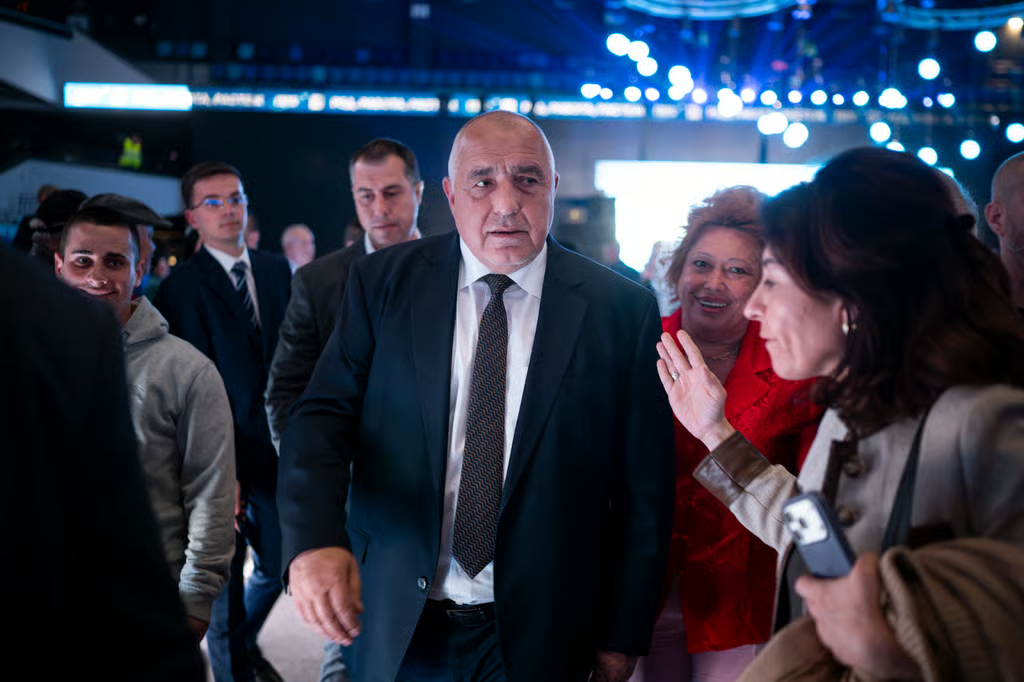
Bulgaria’s former president and air force commander Rumen Radev is leading a closely watched general election campaign built around promises to dismantle entrenched corruption and what he calls the country’s “mafia state.” The vote comes as the country continues to cycle through repeated political collapses and unstable coalition governments.
According to Britain Chronicle analysis, Radev’s rise reflects a deep public exhaustion with Bulgaria’s political system rather than a clear mandate for a defined governing programme. His appeal is rooted in frustration, but his ability to convert that momentum into stable leadership remains uncertain.
The election marks Bulgaria’s eighth national vote in five years, underscoring a state increasingly trapped in political deadlock. With no government completing a full term since 2021, the country’s governance structure is under sustained strain.
WHAT HAPPENED?
Bulgaria held another snap general election dominated by Rumen Radev and his newly formed Progressive Bulgaria movement. Early projections place his bloc at around 31 percent, making it the largest single political force but still far from a parliamentary majority.
Radev, a former MiG-29 fighter pilot and ex-president, has centered his campaign on fighting corruption and dismantling oligarchic influence in public institutions. His message has gained traction among voters frustrated by years of instability and repeated elections.
Despite leading the race, he faces the same structural barrier as previous governments: a fragmented parliament where coalition-building is unavoidable but increasingly difficult.
WHY THIS MATTERS
The result highlights a deeper political crisis in Bulgaria, the European Union’s poorest member state, where governance has been repeatedly disrupted by collapsing coalitions and institutional distrust.
The instability also raises concerns in Brussels over Bulgaria’s long-term direction, particularly on eurozone integration and foreign policy alignment regarding Ukraine. Radev’s sceptical stance on both issues has added further uncertainty.
For Bulgarian citizens, the consequences are immediate. Political paralysis has slowed reforms, weakened state institutions, and allowed entrenched networks of influence to remain deeply embedded in public life.
WHAT ANALYSTS OR OFFICIALS ARE SAYING
Political analysts describe Radev as a highly influential but unpredictable figure whose rise is driven more by anti-establishment sentiment than by a structured policy platform.
Observers note that his movement brings together a wide ideological mix, ranging from reformist voices to nationalist elements, creating potential internal contradictions in governance.
Opposition figures argue that this broad coalition masks unresolved divisions on key issues such as foreign policy, economic direction, and relations with the European Union. Concerns have also been raised over proximity to pro-Russian political narratives within parts of his support base.
Polling experts caution that while Radev may lead electorally, his lack of a clear governing framework could become a liability once coalition negotiations begin.
BRITAIN CHRONICLE ANALYSIS
Radev’s rise fits a broader regional pattern where political outsiders gain momentum during periods of institutional collapse but struggle once in positions of responsibility. His campaign strategy has relied heavily on ambiguity, allowing different voter groups to project their expectations onto him.
That flexibility may prove useful at the ballot box, but it creates significant risks in governance. Bulgaria’s fragmented parliament will require precise negotiation, not broad messaging, to form a stable government.
There is also a geopolitical layer to consider. Bulgaria sits between competing European and Russian spheres of influence, and any shift in policy direction under a Radev-led government could affect EU and NATO cohesion.
The central question is whether Radev can transition from a protest-driven political figure into a functional executive leader capable of managing compromise.
WHAT HAPPENS NEXT
Coalition talks are expected to begin immediately, with no party positioned to govern alone. Radev’s movement will likely be forced into negotiations with ideologically diverse groups, increasing the risk of unstable alliances.
If talks fail, Bulgaria could face yet another snap election, extending its cycle of political uncertainty. Even if a government is formed, analysts expect internal divisions to surface quickly over foreign policy and institutional reform.
Hungary’s Orbán Era Ends as Magyar Seizes Power Shift

Bipartisan Push Triggers House Resignations Amid Scandal

Steve Darling: Boost Growth with Access to Work Investment
Viktor Orban election defeat Hungary reshapes EU politics
UK National Security Climate Change: Hinchliff Warns on Eco Crisis

Pressure Builds to Expel Eric Swalwell from Congress row
